Catalog study 001 · October 2026
Finding the finish line in 29,392 incremental games.
Finding a name is easy. Knowing whether it ends, how long it takes, and what happens while you are away is a different research problem.
catalog records
recorded endings
completion-time estimates
Our October snapshot contains 29,392 game records assembled from selected game stores, developer pages, open-source projects, and portals. It is a discovery index, not a census. Looking beyond its size reveals a more useful story: the information needed to choose a game is much less common than a title and a link.
An ending is a useful distinction, not a niche exception
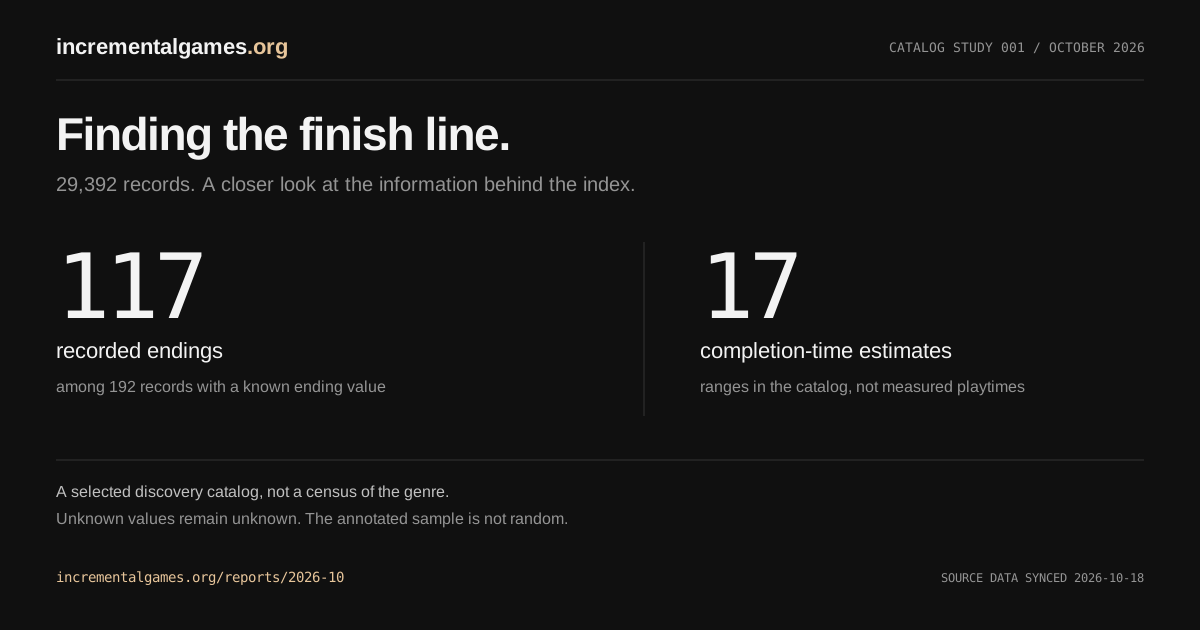
Among the 192 records with an explicit ending value, 117 identify a conclusion and 75 identify open-ended progression. That is 61% with an ending within this known-value sample. It does not mean 61% of all incremental games end: 29,200 records have no ending value, and the annotated sample is selected rather than random.
The practical implication is smaller but stronger. A player who wants to finish something has a real set of options. Our ending guide separates short campaigns from much longer projects instead of treating “finite” and “quick” as synonyms.
Time is the harder question
Only 17 records contain a completion-time range. Those are catalog estimates, not a study of player telemetry or timed playthroughs. We do not calculate a genre-wide average from them.
A finish time can mix active decisions, waiting, offline progress, and strategy. That is why the short-game guide puts pace beside the range and explains what the player will actually do. A few active hours and a week of occasional check-ins can be equally attractive, but they are not the same commitment.
“Offline” needs a second question
260 records contain an offline-progress value: 238 say yes, 15 identify a cap, and 7 say no. The remaining 29,132 are unknown. The 253 positive or capped records do not establish that every system progresses at full speed while closed.
Offline combat rules, storage limits, time caps, and edition differences still matter. Our offline-progress guide treats the flag as the beginning of a decision, not a universal guarantee.
Three levels of evidence in one index
The snapshot contains 75 hand-maintained records, 1,460 with developer-description metadata, and 27,857 name-and-link records. Coverage and verification answer different questions. A large index helps you find a project; a source-backed profile helps you decide whether to play it.
This is also why we keep thin records out of search engines and publish the evidence level rather than pretending every game has been independently reviewed.
Method and limits
Source: a saved response from the public catalog API, compiled into this publication on 2026-10-19. The underlying source data was synced 2026-10-18. This publication stays fixed; the live catalog can differ.
- The unit is a catalog record. Cross-source merging reduces duplicates but does not establish a perfect one-game/one-record census.
- Known-value counts include only explicit values. Unknown does not mean no, endless, inactive, or unsupported.
- The annotated subset favors games where descriptions or editorial information exist. It is not representative of the full genre.
- Platform categories overlap: the same game can have browser, Steam, and mobile releases. Some records have no normalized platform.
- Time and idle values are existing estimates. Offline values are recorded claims, not controlled measurements.
- Store ratings, update dates, prices, and supported editions can change. The CSV preserves the captured values.
The CSV SHA-256 below lets another researcher verify the exact published file. A future correction will be identified rather than silently recapturing the dataset.
Take the data with you
CSV SHA-256: 2287f882e6be375b0c8ed184cb29c3c4c0573c36bfa953bc203a8ab099bcf0d3
Cite this study
IncrementalGames.org. (2026, October 19). Finding the finish line in 29,392 incremental games. https://incrementalgames.org/reports/2026-10Ready to use on a site that accepts this format.
You may reuse the published chart with a clear credit and source link. This does not grant rights to third-party game artwork.