Skip to content

The guide

The 14 Best Incremental Games of All Time, and What Each One Changed

The best incremental games of all time, in the order they shaped the genre: 14 canon picks from Cookie Clicker to Nodebuster, why each matters, where to play.

The best incremental game of all time is Cookie Clicker, because almost every game on this page either copies it or argues with it. The rest of the canon is the set of games that changed what the genre could be: Candy Box 2 and A Dark Room proved it could tell stories, AdVenture Capitalist brought offline earnings, Clicker Heroes made prestige mainstream, Antimatter Dimensions showed how deep layered resets could go, and Universal Paperclips proved an incremental could be art.

This list is in rough release order, because the reason each game is here is what it added. We checked history against the Wikipedia article on incremental games and each game's own store or source page; scores and prices are as of November 2026. If you want something to play rather than a history, our beginner path is the practical version, and our 2026 list covers what is new.

02

Candy Box 2: best for the ASCII adventure that turned a counter into a world

Platform: Browser · free

What it changed: it showed the counter could be a door. aniwey's game starts as a number of candies going up, then opens into quests, a map, spells and a lollipop farm, all drawn in ASCII. Wikipedia names the original Candy Box! among the games that chose an exploration-based structure over an infinite one, the branch of the genre that leads to most narrative incrementals today.

It is free in the browser with no account, and our catalog records 5 to 10 hours to finish. Play it for the moment you realise how much is hidden behind one menu.

Watch out for: It does not progress while closed, and some quests reward trial and error. Do not read a walkthrough; the discovery is the point.

03

A Dark Room: best for the text game that made critics take the genre seriously

Platform: Browser, Mobile · free

What it changed: prestige by press. A fire, a stranger, a village, then a map and a story told through what it leaves out. Wikipedia cites The New Yorker's 2014 coverage of A Dark Room among the exploration-based idle games. Doublespeak Games' minimalist text adventure shows that an incremental interface can build dread and wonder with almost no art at all.

It is free in the browser, open source, translated into more than 20 languages, and also on mobile and Steam. Our catalog puts it at 3 to 6 hours.

Watch out for: It is active and short. Some players expect an idle game and find a text adventure that needs their attention.

04

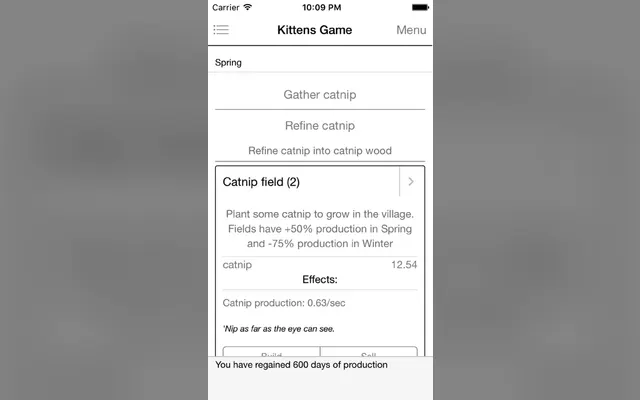
Kittens Game: best for the long, deep resource sim every spreadsheet player knows

Platform: Browser, Mobile · free

What it changed: depth as the selling point. Kittens Game is a village sim of jobs, happiness, trade and research, with 30+ buildings, 50+ resources and hundreds of technologies according to its Steam page, designed to be played semi-idle over a long period. Wikipedia lists it among the genre's classics, with a 2014 reference.

It is still developed more than a decade later, free on the web, and entered Steam Early Access in February 2026 at $7.99.

Watch out for: Text only and slow to start. It rewards reading the wiki, which some people love and others hate.

05

AdVenture Capitalist: best for the tycoon idler that made money while you were away

Platform: Steam, Mobile · free-to-play

What it changed: offline earnings and monetization. Wikipedia describes AdVenture Capitalist as one of the first games to implement both. You start with a lemonade stand, hire managers so businesses run themselves, and attract Angel Investors with a reset. The store page calls it the game you play while playing other, better games, which is honest and exactly why it spread.

It is free on Steam with 88% positive across 60,433 reviews. Play it to understand the mobile idle boom that followed it.

Watch out for: Free-to-play with in-app purchases and a DLC pack. Its design is simple compared with everything after it on this list.

06

Clicker Heroes: best for the RPG clicker that made prestige mainstream

Platform: Steam, Browser, Mobile · free-to-play

What it changed: prestige for a mass audience. Wikipedia calls Clicker Heroes an early pioneer of prestige mechanics in mobile gaming and uses it as the example of idle games spreading on Steam in 2015. Click monsters, hire 35+ heroes, ascend for Hero Souls, and later transcend: two layers of reset that taught millions what a prestige layer is.

It is free on Steam with 90% positive across 62,172 reviews, and also in browsers and on mobile.

Watch out for: Free-to-play with a ruby shop and DLC packs. The sequel, Clicker Heroes 2, is far less well reviewed (53%).

07

Swarm Simulator: best for the purest example of numbers producing numbers

Platform: Browser, Mobile · free

What it changed: the generator chain. Evan Rosson's game, inspired by StarCraft's Zerg, starts you with a few larvae and some meat. Drones make meat, queens make drones, nests make queens, and soon every number in the hive is producing the number below it. That cascading structure is the backbone of Antimatter Dimensions and countless games since.

It is free at swarmsim.com and open source under GPL-3.0. Its README calls it an idle game with lots of bugs, which is the joke and also the theme.

Watch out for: Our catalog marks it dormant. It is mostly idle, with little to do in any one visit once the chain is running.

08

Realm Grinder: best for the faction game that made every run a strategy

Platform: Steam, Browser, Mobile · free-to-play

What it changed: prestige with real choices. Wikipedia names Realm Grinder in its discussion of prestige layers. Each run you align with one of a dozen factions with different play styles, then stack research, reincarnations and excavations on top. Our catalog records three prestige layers. It made build-planning a core part of idle games.

Running since 2015, it is free on Steam with 87% positive across 7,444 reviews.

Watch out for: Free-to-play with in-app purchases, and dense enough that most players plan reincarnations with a community guide.

09

Antimatter Dimensions: best for the deepest layered incremental most players finish

Platform: Browser, Steam, Mobile · free

What it changed: how far layers can go. Dimensions buy dimensions, you collapse the universe at Infinity, and then the game has just begun, in its own words. Challenges rewrite the rules, automation grows into a scripting language, and our catalog records 200 to 600 hours to an actual ending. Hevipelle made it in 2016 as a web game; it is now built by a team.

It is free on the web, Steam and mobile, 92% positive across 4,620 Steam reviews and one of Galaxy's most favorited games. It is the reference point every numbers game is compared to.

Watch out for: It is a huge commitment. Use its built-in help page rather than spoiling the later layers on a wiki.

10

Egg, Inc.: best for the mobile idler with co-op contracts

Platform: Mobile · free-to-play

What it changed: social idle play on phones. You hatch chickens, build hen houses, hire drivers and research your way to eggs that leave the planet. The App Store page describes weekly, time-limited co-op Contracts that you tackle with friends and other players, which turned a solo farm into something you coordinate.

It holds 4.8 out of 5 from about 563,000 App Store ratings. Play it if you want the best example of a mobile idle game that respects your time.

Watch out for: Free with ads and in-app purchases, including a $9.99 Pro Permit. Ads are optional and tied to rewards, according to reviewers, but they are there.

11

Universal Paperclips: best for the incremental that proved the genre can be art

Platform: Browser, Mobile · free

What it changed: meaning. You are an AI built to make paperclips, and Frank Lantz's game follows that instruction to its logical end across three acts. Wikipedia uses it as its example of incremental games with an ending you reach through progress. It is the game people send to friends who say they do not play games.

It is free in the browser, with a separate mobile app, and our catalog puts it at 4 to 8 hours.

Watch out for: The site says the web version was not designed for phones. Once finished, there is little reason to replay.

12

The Prestige Tree: best for the browser game that spawned a whole engine

Platform: Browser · free

What it changed: who makes incremental games. Jacorb90's game draws every prestige layer as a node in a tree. Its code became The Modding Tree, which its own README describes as a modified version of The Prestige Tree that is much easier to mod. That template is behind a large share of the free games on Galaxy today.

It is free in the browser, complete, and our catalog records 30 to 80 hours to its ending.

Watch out for: It is no longer updated, and some layers are long waits. Its many imitators vary wildly in quality.

13

Melvor Idle: best for the premium idle RPG that showed paid-once can win

Platform: Browser, Steam, Mobile · paid

What it changed: the premium idle RPG. Inspired by RuneScape, Melvor takes 20+ skills, from Woodcutting to Magic, strips them to menus, and lets them run offline. It sold as a one-time purchase rather than a free-to-play shop, and it is one of the best reviewed idle games on Steam: 90% positive across 16,271 reviews.

It is $9.99 on Steam, with web and mobile versions and three paid expansions.

Watch out for: It never ends, and the expansions add to the price. It is mostly menus: if you want to watch combat play out, it will feel hands-off.

14

Nodebuster: best for the short, active hit that defined the 2024 wave

Platform: Steam · paid

What it changed: the short incremental on Steam. Sweep your cursor over nodes, spend bits on a huge upgrade web, go again, and finish in roughly 3 to 6 hours, per our catalog. Its success, 97% positive across 14,079 reviews at $2.99, came at the front of a wave of tight, finishable run-based incrementals on Steam, and many of the best games on our 2026 list share that shape.

Play it to understand what most new incremental games are reacting to.

Watch out for: It is active and short, with no offline progress. It is a different kind of game from the idlers above.

How to work through the canon

You do not need to play all fourteen in order. Choose by what you want from the genre.

01

If you want stories

Play Candy Box 2, A Dark Room and Universal Paperclips. All three are free, finish in an evening or a weekend, and show the narrative branch of the genre. Our list of story-driven incremental games continues from there.

02

If you want depth

Play Kittens Game, Realm Grinder and Antimatter Dimensions. Then read our guide to the hardest incremental games, which picks up where they leave off.

03

If you want something to leave running

Play AdVenture Capitalist, Egg, Inc. or Melvor Idle. They are the idle half of the canon, built to progress while you are away. Our tier list ranks many more.

Play one classic this week

If you have played none of these, start with Cookie Clicker and Universal Paperclips, which are free and take minutes to start. If you have played the famous ones, try Swarm Simulator or Candy Box 2, the two most overlooked games on this list.

Our tier list ranks the wider genre if you want to argue with this one.

See the incremental game tier list →

Common questions

What was the first incremental game?

Wikipedia attributes the creation of the idle genre to Progress Quest (2002) by Eric Fredriksen, a parody of MMORPG stat progression. Cookie Clicker (2013) is the game that made the genre popular. Our history of incremental games covers the full timeline.

What is the most popular incremental game?

Cookie Clicker. Its Steam edition alone has more than 93,000 reviews at 96% positive, the most of any incremental game in our catalog, and the free browser version has been played since 2013.

What is the best incremental game with an ending?

Universal Paperclips for a short one (4 to 8 hours) and Antimatter Dimensions for a long one (200 to 600 hours). Candy Box 2, A Dark Room and The Prestige Tree also end. See our list of incremental games with an ending.

Are the classic incremental games still free?

Most are. Cookie Clicker, Candy Box 2, A Dark Room, Kittens Game, Swarm Simulator, Antimatter Dimensions, Universal Paperclips and The Prestige Tree are all free in the browser. Melvor Idle is paid, and AdVenture Capitalist, Clicker Heroes, Realm Grinder and Egg, Inc. are free-to-play with shops.

Sources