Skip to content

The guide

11 Incremental Games for Beginners, in the Order to Play Them

Incremental games for beginners, in play order: 11 picks that each teach one new idea, from Cookie Clicker to Antimatter Dimensions, with time and cost.

Start with Cookie Clicker, then play Universal Paperclips, then A Dark Room. Those three are free, run in a browser, and between them teach the three things every incremental game is built from: producers that multiply, systems that open up as you go, and a game that reveals itself slowly. Everything after them on this list adds one new idea at a time, ending with Antimatter Dimensions, the game most players graduate to.

Most beginner lists are a pile of famous names. This one is a path: each entry says what it teaches and why it comes where it does, so you never hit a prestige layer or an offline-progress system before you know what one is. Hours come from our catalog where we track them, and prices are Steam US base prices in November 2026.

02

Universal Paperclips: best for seeing how far one button can unfold

Platform: Browser, Mobile · free

What it teaches: systems that open up. You start by clicking a button that makes one paperclip, and the game keeps adding layers: pricing and demand, marketing, computing power, and further shifts that are best left unspoiled. Frank Lantz's game has three acts and a real ending. Our catalog puts it at 4 to 8 hours.

Play it second because it proves incremental games can have a beginning, middle and end, and that a menu of numbers can tell a story. It is free in the browser.

Watch out for: Its site says the web version was not designed for phones; there is a separate mobile app. Play on a computer if you can.

03

A Dark Room: best for learning that the interface itself can hide the story

Platform: Browser, Mobile · free

What it teaches: the reveal. The screen says the fire is dead and the room is freezing, and there is one button: light fire. From there, Doublespeak Games' minimalist text adventure grows a village, a map and a story told almost entirely through what it leaves out. It has an ending, and our catalog puts it at 3 to 6 hours.

Play it third because it shows the other half of the genre's appeal: curiosity about what the next button will be, not just bigger numbers. It is free in the browser, open source, and available in more than 20 languages.

Watch out for: Unlike most games here, it needs you present: it does not progress while closed, and the exploration section asks for active attention.

04

SPACEPLAN: best for a funny two-hour clicker with a soundtrack

Platform: Steam, Mobile · paid

What it teaches: pacing. You use manual clicks and the passage of time to power a satellite and launch potato-based probes, across five planets and two realities, according to its store page. It is, in its own words, based partly on a total misunderstanding of Stephen Hawking's A Brief History of Time. Our catalog records 1 to 3 hours.

Play it fourth as your first paid incremental. At $2.99 on Steam, with 91% positive reviews across 3,439, it is a low-risk way to find out whether you like the genre enough to spend money on it.

Watch out for: It is short and linear, with little reason to replay. If you would rather keep things free, skip to Progress Knight and come back to it.

05 · Ours

Mushies!: best for a gentle first prestige reset in a cozy village

Platform: Browser, Steam

Mushies! is made by the person who maintains this site, so take the placement with that in mind. What it teaches: a prestige loop you can see. You click a big mushroom for spores, hire worker shrooms and build a village, then reset it in exchange for permanent Wisdom, which makes the next village grow faster. The Steam page describes an active game with a story and a definitive ending, about three to four hours long.

It sits here because a prestige reset is easier to understand when you watch a little village come back faster. The free demo runs on this site and on itch.io; the full game is upcoming on Steam.

Watch out for: The full game is not released yet, so the demo is only a slice. It does not progress while closed.

06

Tower Wizard: best for your first complete prestige game, start to finish

Platform: Steam · paid

What it teaches: prestige as a way to go faster, not just start over. You gather magic, summon spirits to collect resources, construct buildings and grow a wizard tower, and the store page lists prestige to replay and progress faster, plus a definite ending. Our catalog puts it at 3 to 5 hours.

It is $2.99 and one of the highest rated incrementals on Steam: 97% positive across 8,956 reviews. Play it after Mushies! because it takes the same reset idea and builds a whole short game around it.

Watch out for: It is active: the store calls it an active incremental, and it will not get far if you leave it in the background. Windows only.

07

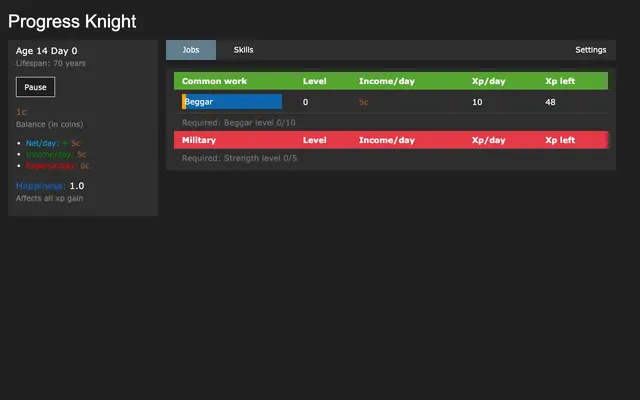
Progress Knight: best for understanding rebirth through one lifetime at a time

Platform: Browser · free

What it teaches: loops and lifespans. You begin as a beggar, take jobs and train skills to afford better jobs, and choose between labor, the military or a magic academy. Then you grow old. Its README explains that you can prestige for experience multipliers based on how the life went, and that later lives regain levels much faster. Our catalog records 8 to 20 hours.

Play it here because it turns prestige into something with a story reason, and it is the first game on this list where planning your run matters. It is free and open source, and you can play it on this site.

Watch out for: Our catalog marks it dormant, so it is not getting updates. The text-and-progress-bar interface looks plain next to the games above.

08

The Prestige Tree: best for meeting many prestige layers without getting lost

Platform: Browser · free

What it teaches: layers on layers. Jacorb90's game is drawn as a tree where every node is its own prestige layer, so you can see how resetting one feeds the next. It has an ending, and our catalog puts it at 30 to 80 hours. Its engine became The Modding Tree, the base for a huge number of browser incrementals.

Play it once you are comfortable with a single prestige. After this, you will recognise the structure of most free incrementals on Galaxy at a glance.

Watch out for: Some layers are long waits. The game is complete and no longer updated, which also means it will not change under you.

09

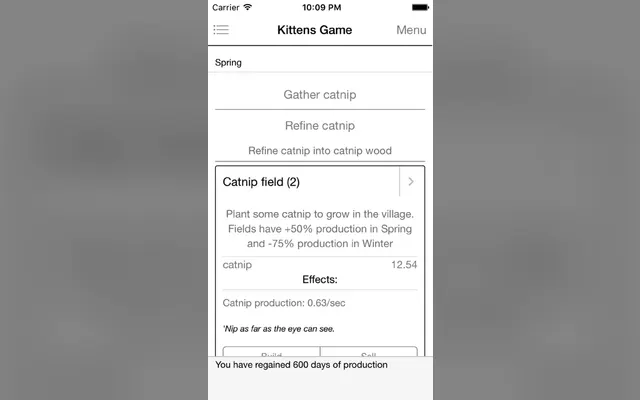
Kittens Game: best for learning to manage many resources at once

Platform: Browser, Mobile · free

What it teaches: resource management. You run a village of kittens, assign jobs, balance happiness, trade and research. The Steam page counts 30+ buildings, 50+ resources and hundreds of technologies, and says the game is designed to be played over a long period in a semi-idle way, as actively or hands-off as you like.

Play it once you are ready for a game measured in weeks. It is free in the browser, and a Steam Early Access version launched in February 2026 for $7.99.

Watch out for: It is text-only and slow to start, and storage limits waste production if you leave for too long. Expect to keep notes or check the wiki.

10

Melvor Idle: best for your first idle game that plays while you are away

Platform: Browser, Steam, Mobile · paid

What it teaches: offline progression and long-term goals. Inspired by RuneScape, Melvor gives you 20+ skills, from Woodcutting and Smithing to Melee, Ranged and Magic, and they feed each other. You pick what to train, close the game, and come back to the results. Its store page lists offline progression and cloud saves.

Play it here because it is the gentlest way to learn the idle half of the genre. It is $9.99 on Steam with 90% positive reviews across 16,271, and three expansions are sold separately.

Watch out for: It is paid, not free-to-play, and the expansions add up if you buy them all. It never ends, so set your own goals.

11

Antimatter Dimensions: best for graduating from beginner to the deep end

Platform: Browser, Steam, Mobile · free

What it teaches: everything at once. You buy dimensions that produce the dimension below them, reach Infinity and earn an Infinity Point, and then, as the Steam page puts it, the game has just begun. Challenges change the rules, automation grows into a custom scripting language, and the layers keep coming. It has an ending, and our catalog records 200 to 600 hours.

Play it last because it uses every idea above: multipliers, unfolding systems, prestige, multiple layers and idle play. It is free on the web and Steam, and if you finish it, you are no longer a beginner.

Watch out for: Hundreds of hours is a real commitment, and some walls only break with patience. Its built-in help page is good; read it before the wiki.

How to use this list

You do not have to play all eleven. Use the order as a ladder and stop on the rung you like.

01

Start free, then decide

The first three are free and browser-based, and so are Progress Knight, The Prestige Tree, Kittens Game and Antimatter Dimensions. Spend money only once you know you like the genre: SPACEPLAN and Tower Wizard cost $2.99 each.

02

Pick short or long on purpose

Universal Paperclips, A Dark Room, SPACEPLAN and Tower Wizard all end within an evening or a weekend. Kittens Game, Melvor Idle and Antimatter Dimensions are measured in weeks or months. Our how long to beat page lists hours for many more.

03

Notice which half you enjoy

If you liked clicking and short runs, go on to our Steam clicker list. If you liked checking back for progress, go to truly idle games. If you liked the story in Paperclips and A Dark Room, see story-driven incremental games.

Play the first one tonight

Open Cookie Clicker in a tab, buy your first Grandma, and leave it running while you read about the rest. If you like the feeling of a number you no longer have to click for, you will like this genre.

When you finish the list, or want to skip ahead, our finder matches you to a game in a few questions.

Find your next game in two minutes →

Common questions

What is the best incremental game for beginners?

Cookie Clicker. It is free in the browser, teaches the core loop in minutes, and introduces prestige gently. If you want something with an ending instead, start with Universal Paperclips.

What is the difference between an incremental game and an idle game?

An incremental game is any game built on numbers that grow and upgrades that make them grow faster. An idle game is an incremental that keeps progressing with little or no input. Most games here are both. Our explainer on incremental vs idle games covers it with examples.

What does prestige mean in incremental games?

Prestige is a voluntary reset: you give up your current progress in exchange for a permanent bonus that makes the next run faster. Cookie Clicker calls it ascension. Our guide to prestige in idle games explains the variations.

Are there incremental games for beginners that have an ending?

Yes. Universal Paperclips, A Dark Room, SPACEPLAN and Tower Wizard all have endings and take an evening to a weekend. Antimatter Dimensions has one too, but it takes hundreds of hours.

Do I need to download anything to start?

No. Cookie Clicker, Universal Paperclips, A Dark Room, Progress Knight, The Prestige Tree, Kittens Game and Antimatter Dimensions all run in a desktop browser for free.

Sources