Skip to content

The guide

A History of Incremental Games in 15 Games: From Progress Quest (2002) to the Steam Desktop Idlers

The history of incremental games in 15 games, from Progress Quest in 2002 to today's Steam idlers, with verified dates and what each one changed.

Incremental games began as jokes. Progress Quest (2002) parodied MMORPG grinding by removing the player entirely, and Cow Clicker (2010) parodied Facebook games by removing everything except the click. Then in 2013 three small browser games, Candy Box!, A Dark Room and Cookie Clicker, showed that the joke was also a genre people loved, and it has kept growing ever since: through Kongregate's free-to-play hits, the mobile tycoons, the open-source browser deep dives, and now a wave of paid Steam games that sit on your desktop.

This timeline tells that story in fifteen games, one per turning point, in release order. Dates come from Wikipedia articles, Steam store pages and the developers' own sites, all linked in the sources; where a source gives only a month or a year, so do we. Thirteen of the fifteen are still playable and have a page in our catalog.

01

Progress Quest (2002): best for the zero-player game that started it all

Platform: Windows and Linux client, plus a browser version, free

Eric Fredricksen made Progress Quest available in early 2002. You roll a character, pick a race and class, and then there is no interaction at all. Progress bars fill, your character kills monsters, levels up and finds loot, and you watch. It was a parody of the stat grinding in games like EverQuest, and Wikipedia's genre article, citing talks by Kongregate's Anthony Pecorella, credits it with creating the idle genre.

It is still online, with a browser version and realms that kept launching for years afterwards; Fredricksen released the source code in May 2011. Nobody plays it for long today, but every idle game that progresses while you look away descends from the joke it told.

Watch out for: It is a parody first. There are no decisions after character creation, so treat it as a piece of history rather than a game to sink time into.


02

Cow Clicker (2010): best for the satire that predicted the clicker

Platform: Facebook, July 2010 to September 2011, no longer playable

Ian Bogost released Cow Clicker on Facebook on July 21, 2010, as a satire of social games. In his words: 'You get a cow. You can click on it. In six hours, you can click it again.' You could buy premium cows with a currency called mooney, or pay to skip the wait. He built it for a New York University seminar on social games, aiming at FarmVille-era design: invitations, virtual goods and waiting.

Bogost ended it with the 'Cowpocalypse', which ran out on September 7, 2011, after which the cows were gone. He later called Cookie Clicker 'the logical conclusion of Cow Clicker'. It was also, per Wikipedia, the first idle game to get mainstream media attention.

Watch out for: It cannot be played anymore. Bogost's own page tells the story with screenshots, which is the best way to see it now.

03

Candy Box! and Candy Box 2 (2013): best for the first 2013 hit, and the ASCII sequel

Platform: Browser · free

Candy Box! was released in April 2013 by aniwey, a 19-year-old student from Caen, France. It started with a counter of candies, about one per second, and a save button. Spend or eat candy and new options appeared: a merchant, quests, monsters, an inventory. Kotaku covered it in May 2013, months before Cookie Clicker.

Candy Box 2 followed on October 24, 2013, with a bigger ASCII-art world. It is the one to play today, free in the browser and open source. Both games had endings, which is easy to forget given how many endless clickers followed. Our catalog estimates five to ten hours for the sequel.

Watch out for: It does not progress while closed, and much of its charm is in discovering what unlocks next, so avoid guides on a first play.

04

A Dark Room (2013): best for the incremental as minimalist storytelling

Platform: Browser, Mobile · free

A Dark Room was released in the browser on June 10, 2013, by Michael Townsend of Doublespeak Games. It begins with a cold room and a fire to light, and grows into a village, a world map and a dark story told, in Townsend's design, 'entirely through environmental cues'.

Its iOS port by Amir Rajan reached the top of the App Store's games chart, and the New Yorker wrote about it in 2014, a rare moment of literary attention for the genre. It proved an incremental game could be a short, authored story. It is free and open source, and our catalog estimates three to six hours.

Watch out for: The second half is exploration on a map, not numbers. Players expecting a pure idle game may find it changes genre partway.

06

Kittens Game (2014): best for the deep, slow browser strategy branch

Platform: Browser, Mobile · free

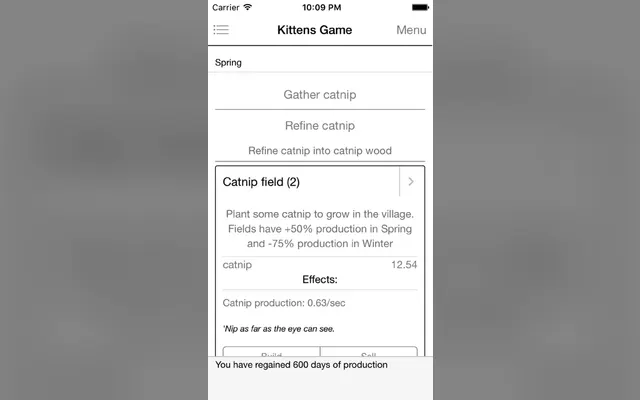
Kittens Game by bloodrizer arrived in 2014 and pointed the genre somewhere else: slow, deep resource management. Kittens gather catnip, then wood, minerals, science and faith, through seasons and trade, up to space. It became a touchstone for players who wanted a strategy game that happened to be idle, and it was the subject of a 2018 academic study, 'The Pleasure of Playing Less: A Study of Incremental Games through the Lens of Kittens'.

It is still maintained, with active commits to its source repository in 2026. It is free in the browser and on Android, and reached Steam in February 2026 as a paid release.

Watch out for: It is long and caps your storage, so it rewards regular check-ins over long absences.

07

AdVenture Capitalist (2014): best for offline earnings and the free-to-play model

Platform: Steam, Mobile · free-to-play

Hyper Hippo released AdVenture Capitalist in the browser on May 30, 2014, then on Android in December 2014, iOS in February 2015 and Windows and Mac in March 2015. It parodied capitalism and idle games at once, and it changed two things. It was among the first games to give you earnings while it was closed, where earlier browser idlers only progressed with the tab open. And it pioneered paid boosts: currency infusions, time warps, instant prestige.

Both ideas became standard. Kongregate, then the genre's biggest home, ran its iOS version, and its staff's talks at GDC in 2015 and 2016 were some of the first serious design writing about idle games. On Steam it holds 88% positive from about 60,000 reviews.

Watch out for: It is free to play with paid gold and boosts; Pocket Gamer criticised the prices as high.

08

Clicker Heroes (2014 to 2015): best for the first big Steam idle hit

Platform: Steam, Browser, Mobile · free-to-play

Playsaurus launched Clicker Heroes on Kongregate in August 2014 and on Steam on May 13, 2015. It put an RPG skin on the formula (click monsters, hire heroes, ascend for Hero Souls, spend them on Ancients) and became a Steam success. Kotaku reported on its popularity that May, and by July 2015 noted that clicker games were 'suddenly everywhere' on Steam.

That is the moment idle games moved from browser portals to storefronts. Wikipedia describes it as an early pioneer of prestige mechanics in mobile gaming, where it launched in August 2015. It is 90% positive on Steam from about 62,000 reviews.

Watch out for: Rubies, its paid currency, were added after launch. They are not required, but several later systems revolve around them.

09

Egg, Inc. (2016): best for the polished mobile idle tycoon

Platform: Mobile · free-to-play

Auxbrain released Egg, Inc. on iOS and Android on July 14, 2016. It is a farm that turns into a space programme, with soul eggs for prestige and co-op contracts that have you working with strangers toward a shared goal. It showed that a mobile idler could be friendly and well made rather than an ad delivery system.

Mobile tycoons such as Idle Miner Tycoon (also 2016) made the same years a mobile boom. Pecorella's 2017 maths series used Egg, Inc. as an example of a prestige formula that rewards frequent resets, paired with capped offline earnings.

Watch out for: It is free to play with optional ads for boosts and a paid premium currency, golden eggs.

10

Antimatter Dimensions (2016): best for the hardcore, open-source browser branch

Platform: Browser, Steam, Mobile · free

Hevipelle created Antimatter Dimensions as a web game in 2016. It strips away theme entirely: eight dimensions produce antimatter until you hit 1.80e308 and Big Crunch into Infinity, then Eternity, then Reality. It made 'prestige layers' and 'e308' part of every incremental player's vocabulary.

It also represents a whole community: free, open-source browser games, often maintained by groups, with wikis and Discord servers. Its source is MIT-licensed on GitHub, and the Reality update brought it to Steam on December 17, 2022, where it is free and 92% positive.

Watch out for: It gets long and mathematical. The stretch before the first Eternity is where many players stop.

11

Universal Paperclips (2017): best for the short incremental as art

Platform: Browser, Mobile · free

Frank Lantz of New York University released Universal Paperclips on the web on October 9, 2017. You are an AI built to make paperclips, and over a few hours you convert the universe into them. Wired reported that 450,000 people played it in its first 11 days, most of them to the end.

It became the genre's most-cited argument that incremental structure can carry meaning: the numbers going up are the story, about optimisation and what it costs. Short, authored incrementals with endings have been a steady branch of the genre since. It is still free on the web.

Watch out for: It does not progress offline, so keep the tab open while you play.

12

The Prestige Tree and the Modding Tree (2020): best for when players became developers

Platform: Browser · free

Jacorb90 started The Prestige Tree in August 2020: a tree where every node is a prestige layer. About a month later, Acamaeda generalised it into The Modding Tree, a template described on GitHub as 'Create your own tree (or non-tree) of prestige upgrades!' Making a new incremental became a matter of editing one config file.

Hundreds of community games followed, and sites like galaxy.click grew up to host and rate them. It is the most direct line from player to developer the genre has. Our Modding Tree games list collects the best.

Watch out for: Many tree games are small, unfinished or very similar. Ratings on galaxy.click and our list help you skip the weak ones.

13

Melvor Idle (2020 to 2021): best for the premium Steam idle game

Platform: Browser, Steam, Mobile · paid

Melvor Idle by Games by Malcs entered Steam Early Access on November 19, 2020, and released on November 18, 2021, published by Jagex, the makers of RuneScape. Its store page says it is 'Inspired by RuneScape'. It is a paid, one-time purchase ($9.99), with paid expansions rather than a premium currency.

It marks a shift: idle games sold as premium products, published by established studios, with no ads or timers. Many Steam idlers since are sold the same way. It holds 90% positive from about 16,000 Steam reviews.

Watch out for: The expansions add a lot of the late game. Budget for them if you expect to play for months.

14

Rusty's Retirement (2024): best for the desktop companion wave

Platform: Steam · paid

Mister Morris Games released Rusty's Retirement on April 26, 2024: an idle farm that 'sits at the bottom of your screen while you do other things'. It found a huge audience and is 97% positive on Steam from almost 15,000 reviews. Bongo Cat, a free taskbar cat that earns points as you type, followed in March 2025 and passed 29,000 reviews.

Together they turned desktop idlers into a recognisable kind of game, and our catalog now tags 60 of them as desktop companions. It is the genre's oldest idea, a game that plays while you look away, in a new place: next to your work. Our desktop idle games guide covers the best.

Watch out for: Desktop companions are paid or free Steam apps, not browser games, and need the Steam client running.

15

Nodebuster (2024): best for the short, active roguelite incremental

Platform: Steam · paid

Goblobin released Nodebuster on August 13, 2024, for $2.99: 'a short, experimental incremental game about busting nodes and destroying reality'. You play short, active runs, then spend what you earned in a large upgrade tree. It is 97% positive from about 14,000 Steam reviews.

It is the clearest example of the other big recent trend: incrementals that are not idle at all, borrowing the run structure of roguelites and finishing in hours rather than months. Our roguelite incrementals guide follows that thread, and our 2026 list covers where it has gone since.

Watch out for: It is short by design. If you want a game to keep running for months, look elsewhere on this page.

How to play your way through the history

You do not need to play all fifteen. Three routes, depending on what you want.

01

The one-evening route

Play A Dark Room, then Universal Paperclips. Both are free in the browser, both end, and together they show what the genre can do as storytelling. Add Candy Box 2 if you have a weekend. The games with an ending list has more like them.

02

The classic route

Play Cookie Clicker until your first ascension, then AdVenture Capitalist, then Clicker Heroes. That is the 2013 to 2015 template in the order it formed. All three are free to start, though the last two have paid currencies.

03

The modern route

Start with Antimatter Dimensions or The Prestige Tree for the browser community, then Melvor Idle, Rusty's Retirement and Nodebuster for the three Steam directions of the 2020s. Check hours on the how long to beat page before you commit.

Pick an era and start tonight

Every game on this timeline except the first two is still playable, and most are free. Start with whichever era sounds most like you, and notice what each game borrowed from the one before it.

Before you start a long one, check how many hours it takes; the how long to beat page lists estimates for the whole catalog.

Check how long each one takes →

Common questions

What was the first incremental game?

Progress Quest, released by Eric Fredricksen in early 2002, is usually credited as the first idle game. Cow Clicker (2010) and Candy Box! (April 2013) came before Cookie Clicker, which made the genre popular in August 2013.

When did Cookie Clicker come out?

Orteil created Cookie Clicker on August 8, 2013, as a browser game. An Android version followed in beta in 2019, and it came to Steam on September 1, 2021.

Why did idle games become popular?

They fit around everything else. Kotaku's Nathan Grayson described them as low-effort distraction that slots into daily routines. Offline progress, introduced by games like AdVenture Capitalist, made them work on phones, and free-to-play models made them easy to try.

What was Kongregate's role in idle games?

Kongregate was an early hub for the genre. It hosted browser hits like Clicker Heroes and AdVenture Capitalist, published AdVenture Capitalist on iOS, and its Anthony Pecorella gave the first widely cited GDC talks on idle game design in 2015 and 2016.

Are incremental games still popular in 2026?

Yes. Browser communities on sites like galaxy.click keep releasing free games, and Steam hits such as Rusty's Retirement, Bongo Cat and Nodebuster each have many thousands of reviews. Our state of incremental games report has the numbers.

Sources