Skip to content

The guide

Idle Game Terms Explained: 15 Words Every Incremental Player Uses, Each Shown in a Real Game

Idle game terms explained: prestige, softcap, OoM, e-notation, offline progress and 10 more, each shown in a real game so you know where you will meet it.

Idle game communities talk in shorthand: prestige, softcap, OoM, e308, autobuyer, wall. Most of these words have a precise meaning, and most of them were made popular by one or two specific games. This glossary defines fifteen of the terms you will see in game descriptions, tooltips and forum threads, and shows each one in a real game where you can meet it in the first few hours.

Definitions here come from the games themselves (their store pages, wikis and, for the open-source ones, their code) and from Anthony Pecorella's 'Math of Idle Games' series, written when he was running browser games at Kongregate. Review figures are Steam percentages as of November 2026. If you are new to the genre, start with what an incremental game is and come back here when a word stops you.

02

Prestige currency: best for understanding what carries over a reset

Platform: Steam, Browser, Mobile · free-to-play

A prestige currency is the resource you earn by resetting, and it is usually the only thing that survives. In Clicker Heroes it is Hero Souls: bosses drop them, you collect them when you Ascend, and you spend them on Ancients, permanent characters whose bonuses shape every future run.

The useful question to ask of any game is: what does the prestige currency buy? Sometimes it is a flat multiplier (more souls, more damage). Sometimes it is a shop of upgrades, which turns each reset into a build decision. Clicker Heroes, at 90% positive on Steam, is a good place to see the shop version.

Watch out for: Clicker Heroes also has rubies, a premium currency bought with real money. They are not prestige currency, and you do not need them to progress.

03

Prestige layers: best for games with resets inside resets

Platform: Steam, Browser, Mobile · free-to-play

A prestige layer is one level of reset. Many games stack several, each larger than the last and each resetting the layers below it. Realm Grinder by Divine Games is the textbook case: you abdicate often, reincarnate less often, and ascend rarely, and each layer unlocks new factions and research.

When a game advertises 'five prestige layers' or 'many reset layers', this is what it means. More layers usually means a longer game with more decisions, not a harder one. Realm Grinder holds 87% positive on Steam and lets you choose among about a dozen factions.

Watch out for: Layered games front-load the explanation. If the first reset is confusing, play past it; the second layer often makes the first make sense.

04

Generators and tiers: best for seeing why numbers explode

Platform: Browser, Mobile · free

A generator is anything that produces a resource over time. A tier is a generator that produces other generators. In Swarm Simulator, larvae become drones, queens make drones, nests make queens, and so on up the chain, so the higher tiers multiply everything beneath them. That is why its numbers get large very quickly.

Once you notice tiers, you see them everywhere: Antimatter Dimensions' eight dimensions, Cookie Clicker's grandmas and farms (a flat version), Kittens Game's resource chains. Swarm Simulator is free in the browser, open source, and shows you what your swarm produced while you were away when you come back.

Watch out for: It saves to your browser's local storage. Export your save from the options screen before clearing browser data, and note the site says it does not support Safari.

05

Cost scaling and milestones: best for understanding why the 25th purchase feels great

Platform: Steam, Mobile · free-to-play

Cost scaling is how much more each purchase costs than the last. In AdVenture Capitalist, the next Lemonade Stand costs 1.07 times the previous one, according to Pecorella's analysis of the game; in Cookie Clicker, buildings go up 15% each. Costs grow exponentially, so every generator eventually becomes too expensive to keep buying.

Milestones are the counter-weight. AdVenture Capitalist doubles a business's output when you own 25 and then 50 of it, so there is always a target worth saving for. When a game shows a progress bar toward '100 owned', that is a milestone.

Watch out for: AdVenture Capitalist is free to play with paid gold and time warps. The milestones are reachable without paying, but slower.

06

Softcap (and hardcap): best for the moment growth suddenly slows

Platform: Browser · free

A softcap is a threshold past which a gain still increases, but much more slowly, usually by raising it to a power below 1. A hardcap is a limit you cannot pass at all. The Prestige Tree by Jacorb90 is full of softcaps; its code has a dedicated softcap function, and the game has an option to show a 'Softcap Node' once you earn the right achievement.

Softcaps are how developers stop a strong combination from breaking the game. Players grumble about them (there is a joke game literally called Too Many Softcaps), but they are also why the next layer feels like a release. The Prestige Tree is free in the browser and spawned the Modding Tree engine and its many descendants.

Watch out for: Softcaps are often hidden. If a number stops responding to upgrades the way it used to, check the tooltip or wiki before assuming you have done something wrong.

07

OoM (order of magnitude): best for reading late-game upgrade text

Platform: Browser · free

An OoM is an order of magnitude: a factor of ten. Going from 1e50 to 1e53 is three OoMs. Late-game incrementals talk in OoMs because ordinary multipliers stop being meaningful. Incremental Mass Rewritten writes it straight into upgrade text, with effects like 'Mass gain is boosted by OoM of Dark Matters', and even calculates how many OoMs per second you are gaining once numbers get absurd.

You will also see OoM^2, an order of magnitude of the exponent, in the same game. If an upgrade is described per OoM, it is scaling with the logarithm of a resource, which is why it keeps mattering no matter how big the number gets.

Watch out for: Incremental Mass Rewritten is free in the browser and very long. Its numbers move into e-notation within minutes, so read the next entry first if you are new.

08

Storage cap: best for games where waiting can waste production

Platform: Browser, Mobile · free

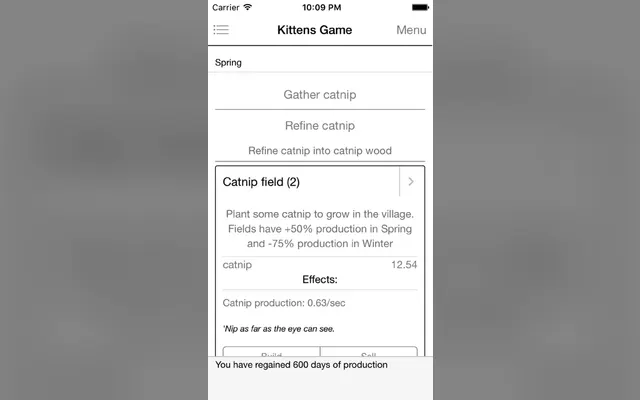
A storage cap is the maximum amount of a resource you can hold. Once you hit it, production above the cap is lost. Kittens Game uses caps on almost every resource, so building barns, warehouses and harbours is as important as building producers.

Caps change how a game feels to idle. A capped game rewards checking in before storage fills; an uncapped one rewards leaving it alone. Kittens Game also has a reset where kittens count toward karma and paragon, and its own confirmation text warns that resetting with fewer than 35 kittens earns no bonus points.

Watch out for: Caps make long absences less efficient. If you want a game to ignore for a day, check whether its key resources are capped first.

09

E-notation, notations and Infinity: best for reading numbers like 1.80e308

Platform: Browser, Steam, Mobile · free

E-notation is scientific notation written short: 1e6 is a million, 1.5e12 is 1.5 trillion. Most incrementals switch to it once numbers outgrow suffixes like 'Qa' and 'Qi'. Antimatter Dimensions takes this furthest: its options offer scientific, engineering, letters, standard, logarithm and more than a dozen joke notations including emoji, Roman numerals and Zalgo text.

The game also made one number famous. At 1.80e308 antimatter (2 to the power of 1024, the largest value a standard 64-bit float can hold) you Big Crunch into Infinity. Players now say 'e308' to mean that wall in any game, and libraries like break_infinity.js exist to let games go past it.

Watch out for: Scientific notation is easier to compare at a glance than named suffixes. If a game offers both, switching early saves you misreading a 'Qa' as a 'Qi' later.

10

Offline progress: best for checking whether a game works while closed

Platform: Mobile · free-to-play

Offline progress means the game calculates what you earned while it was closed and gives it to you when you return. Some games give all of it, some give a fraction, and some cap it at a number of hours. Egg, Inc. by Auxbrain is a well-known capped example; Pecorella's 2017 analysis described it as capping offline play at two hours, with upgrades that extend the window.

A cap is a design choice that asks you to check in a few times a day. For a game you only open once a day, look for uncapped offline progress instead. Our offline progress list records which games have it.

Watch out for: Egg, Inc. is free to play on iOS and Android with ads you can watch for boosts and a paid premium currency, golden eggs.

11

Idle vs active: best for games that reward you for watching

Platform: Steam, Mobile · free-to-play

Active play means you are present and acting: clicking, jumping, timing buffs. Idle play means the game progresses without you. Many games reward both, and players talk about 'active' and 'idle' builds or strategies. Idle Slayer by Pablo Leban makes the split literal: it is a side-scrolling runner where you jump to collect coins and fight enemies when you are around, and it keeps progressing offline when you are not.

The phrase also appears as a rating. Our catalog scores every game from 0 to 100 on how idle it is; Idle Slayer sits at 45, roughly half and half. Its Steam reviews are 84% positive.

Watch out for: Idle Slayer is free to play with in-app purchases on Steam and mobile. Active play is noticeably faster, so pure idlers may feel they are leaving progress on the table.

12

Automation (autobuyers, scripts): best for the point where a game starts playing itself

Platform: Steam · free-to-play

Automation is any upgrade that does something you used to do by hand: an autobuyer that purchases generators, an auto-prestige that resets for you, or a script you write yourself. It is usually unlocked in stages, so the game keeps moving the work you do one level higher.

The Perfect Tower II by Fire Sword Studios goes the furthest. It is a tower defence and town-building incremental, and its Steam page promises you can 'Fully automate your game', including through an in-game scripting language. It is free to play and 87% positive on Steam.

Watch out for: Its scripting system is powerful but takes reading to learn. If you want automation that unlocks by itself, an autobuyer game such as Antimatter Dimensions is gentler.

13

Challenges: best for runs played under special rules

Platform: Browser, Steam · free

A challenge is a run with a handicap, such as a resource disabled or costs multiplied, that rewards you with a permanent bonus when you reach the goal. Challenges let a game reuse its early content in new ways and give layered prestige games something to do between resets.

Synergism by Platonic is built on them. Its Steam page describes a challenge system that builds on itself across playthroughs, inside 'many reset layers'. It launched on Steam in February 2026, is free to play with in-app purchases, and is 76% positive there; the web version has been running since 2020.

Watch out for: Some challenge rewards are required later. If a game marks a challenge as optional, it often is not optional for long.

14

Wall: best for naming the moment progress stops

Platform: Browser · free

A wall is a point where progress slows so much that pushing on is pointless until you prestige, unlock something, or change strategy. Every idle game has walls, and a good one tells you what you need to get past it. Trimps players talk about zone 60 that way: the Trimps wiki notes that from zone 59 you meet Improbabilities, which drop much more Helium, the currency you spend on permanent perks after using the Portal, and community guides describe it as a wall you overcome with more Helium.

Trimps is a free text-based game, in the browser since 2015 and on Steam since 2022, with more than 50 challenges and 'hundreds of perks, talents, and upgrades' according to its store page.

Watch out for: When you hit a wall, the fix is usually a reset, not more waiting. Waiting at a wall is the most common way players burn out of a game.

15

Run, loop and meta-progression: best for life-by-life and time-loop games

Platform: Steam · paid

A run is one pass between resets. In loop games, the run is short and fixed, and the real progress is meta-progression: what carries over. Increlution by Gniller makes each run a life. You queue actions, your character ages and dies, and Instinct levels persist into the next generation so it survives longer.

This is the same structure roguelites use, applied to an incremental, and it has become one of the genre's most popular shapes. Increlution costs $3.99 on Steam, has a free demo, and holds 85% positive reviews.

Watch out for: Increlution has been in Early Access since October 2021 and its store page notes the planned story expansion; check the latest update date before you buy.

How to use these terms when picking a game

The words in a game's description tell you how it will feel. Three things to look for:

01

Count the layers

'Prestige' alone means one reset loop. 'Layers', 'ascension' or a list of reset names means a long, deep game like Realm Grinder or Synergism. If you want something you can finish, look for 'ending' instead, and use the games with an ending list.

02

Check the offline line

Look for 'offline progress', 'progress while away', or a cap in hours. Uncapped offline progress suits once-a-day players; capped games like Egg, Inc. suit people who check in often. Every game page here records offline progress as yes, no or capped.

03

Read 'active' and 'idle' literally

A game that mentions jumping, timing or combos (Idle Slayer) rewards attention. A game that mentions automation, scripts or autobuyers (The Perfect Tower II, Antimatter Dimensions) rewards planning. Our mostly idle list and active list split them for you.

Put the words to work

The quickest way to learn this vocabulary is to play one game that uses most of it. Antimatter Dimensions covers tiers, autobuyers, challenges, notation and layered prestige in its first week; Cookie Clicker covers prestige and cost scaling in its first day.

If you would rather pick by playstyle, the finder turns your answers about attention and time into a short list.

Find a game that fits →

Common questions

What does prestige mean in idle games?

Resetting most of your progress on purpose in exchange for a permanent bonus, usually a currency or multiplier, so your next run is faster. Cookie Clicker calls it ascending; other games call it rebirth, reincarnation or a portal.

What is a softcap in incremental games?

A threshold after which a gain keeps growing, but much more slowly. It is usually done by raising the value to a power below 1. A hardcap, by contrast, cannot be passed at all.

What does OoM mean?

Order of magnitude, a factor of ten. Players use it to compare huge numbers: 1e100 to 1e110 is ten OoMs. Upgrades described 'per OoM' scale with the logarithm of a resource.

What does e308 mean in idle games?

About 1.8 times ten to the 308th power, the largest number a standard 64-bit float can store. Antimatter Dimensions uses it as Infinity, its first big reset, and players use 'e308' as shorthand for that wall in any game.

What is the difference between offline progress and idle progress?

Idle progress happens while the game is open but you are not interacting. Offline progress happens while the game is closed, calculated when you return. Some browser games have the first but not the second.

Sources