Skip to content

For developers

15 Idle Game Ideas Already Proven by Real Games, Plus 45 Twists to Make Them Yours

15 idle game ideas, each proven by a real game players already love, with why the hook works and 45 twists you can build on without making a clone.

Most lists of idle game ideas are themes: space, cooking, zombies. A theme is not an idea. An idea is a hook that changes how the loop feels: where the game lives, what counts as input, what resets, what the numbers mean. Each of the fifteen ideas below is a hook a real game has already proven works, with the evidence (its store page, reviews or play counts) and three twists you could build on it.

We picked games across browser, Steam and mobile, mostly from the last few years, so the ideas reflect what players are responding to now. Review percentages are from Steam as of November 2026 and play counts are from galaxy.click. The twists are our suggestions, not features of those games. One entry is the site maintainer's own game and is labelled.

01

Put the game in the corner of the screen: best for Steam games people keep open all workday

Platform: Steam · paid

Desktop Defender by Conradical Games is 'an idle auto-battler that sits in the corner of your screen while you do other things'. One tower defends against endless waves in a small window you can resize and move, drops gear, and resets runs for Ascendium that carries over. It released in November 2025 for $4.99 and holds 92% positive from about 1,800 reviews.

The hook is placement, not mechanics: a game that never asks for the whole screen gets played for hours a day. Rusty's Retirement proved the audience at scale in 2024.

Twists to try: a strip along the top edge that reacts to which app is focused; a two-monitor version where the game lives on the second screen and sends small events to the first; a desktop pet that wanders between your windows and gathers from their edges.

Watch out for: Desktop idlers live or die on performance. A game that eats CPU in the background gets uninstalled, so profile idle power use early.


02

Turn ordinary input into currency: best for the smallest possible game with a huge audience

Platform: Steam · free

Bongo Cat by Irox Games puts a cat on your taskbar that drums every time you press a key, turning your everyday typing and clicking into points and random hat drops. It is free on Steam and holds 96% positive from almost 30,000 reviews since March 2025.

It works because the player does not have to do anything new. Work they were already doing becomes the clicker. That inverts the genre's oldest tension between playing and not playing.

Twists to try: mouse distance travelled as the resource that powers a vehicle; time spent in a focus app as fuel for a garden; words typed as ink for a growing library, where longer words are rarer.

Watch out for: Global keyboard and mouse hooks raise privacy questions. Say clearly what you read (key counts, not keys) and keep it local.

03

Make real time the resource: best for calm games players check once a day

Platform: Steam · free

Viridi, from Ice Water Games, released in August 2015, is a small pot of succulents that grow in real time. Its store page describes a calm space you can leave open while working or check on each evening. Plants need watering and can die from too much or too little. It is free, sells extra plants for a few cents each with a weekly free seed, and holds 91% positive across its English Steam reviews.

Real-time growth turns the idle genre's waiting into the point. There is nothing to optimise, only to tend, which reaches players who do not like number-heavy games at all.

Twists to try: a slow aquarium whose ecosystem drifts with the real season; a bonsai you shape once a week; a letter-writing game where replies arrive in real days.

Watch out for: Real-time games are easy to forget. Without a gentle reason to return, such as a bloom or a visitor, players drift away by week two.

04

Let the theme be the consequence: best for short games people write essays about

Platform: Browser, Mobile · free

Universal Paperclips by Frank Lantz casts you as an AI told to make paperclips. Optimising the loop is the story: you automate, manipulate markets, then consume the planet and the universe. Wired reported 450,000 players in its first 11 days, most of them to the end.

The hook is that the player's efficiency is the horror. Every upgrade feels good and means something worse. That gives a short incremental an ending people talk about.

Twists to try: a social media manager whose engagement upgrades slowly hollow out the town; a mining company that can only grow by draining a lake you can see; a recommendation algorithm that learns from the player's own choices.

Watch out for: The message cannot replace the loop. Lantz's game is also a tight, well-paced incremental; a heavy theme on a dull loop will not carry.

05

Make code the automation: best for players who are, or want to be, programmers

Platform: Browser, Steam · free

Bitburner is a cyberpunk hacking incremental whose Steam page says simply: 'Write scripts in JavaScript to automate your gameplay.' The upgrade is your own code. It is free, open source, and holds 95% positive from more than 7,000 Steam reviews; The Farmer Was Replaced proved the idea again in 2025 with a Python-like language.

Every idle game automates eventually. Letting the player write the automation makes it the most satisfying unlock in the genre, and gives the game a community that shares scripts.

Twists to try: a visual node language instead of text, for players who do not code yet; a spreadsheet-formula game where cells are your workers; a kitchen where you write recipes as step lists for robot cooks.

Watch out for: Sandboxing user code is real work. If players run JavaScript in your game, keep it away from saves and anything that touches the network.

06

Make prestige a new life: best for explaining resets without a tutorial

Platform: Browser · free

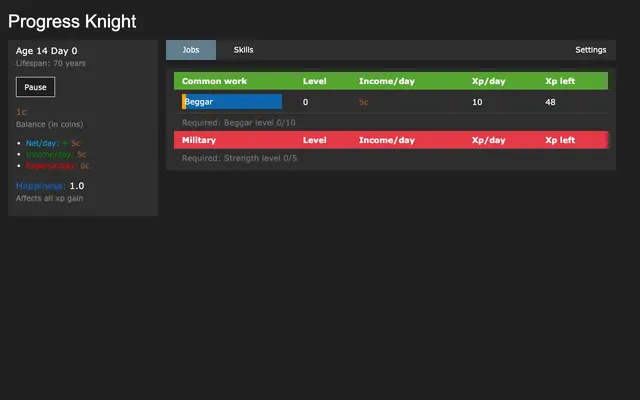
Progress Knight starts you as a beggar and lets you climb jobs and skills. Your character ages, and you can prestige into a new life with XP multipliers based on how well this one went, at the cost of your levels and assets. Its README promises you will regain levels 'much, much more quickly'. It is free, open source, and our catalog rates it 85 idle.

Ageing and dying give the reset a reason everyone understands. Increlution and Your Chronicle use the same frame, which tells you it is a durable idea rather than a one-off.

Twists to try: a dynasty game where each heir inherits one trait you choose; a tree whose seeds remember the last tree's best branch; a town that is rebuilt by the descendants of the last one.

Watch out for: Life-loop games need the second life to feel different, not just faster. Unlock one new option per life early on.

07

Make the math the content: best for math lovers and teachers

Platform: Mobile · free-to-play

Exponential Idle by Gilles-Philippe Paille (Conic Games) is a math-themed idler where you 'stack up money by taking advantage of exponential growth'. The upgrades are terms in an equation, and later stages add custom theories that players can create and share. It is free on iOS and Android, with an optional $1.99 permanent ad reward, and rated 4.9 stars from about 4,100 App Store ratings.

It proves that players will engage with real mathematics if every term they learn makes a number go up. The equation on screen is the progress bar.

Twists to try: a geometry game where you buy new polygon sides and the area is your income; a probability game where you tune distributions; a compound-interest game that teaches real personal finance.

Watch out for: Math games have a small ceiling for casual players. Keep the first equation simple enough to read without help.

08

Teach something real: best for a broad audience and classroom appeal

Platform: Steam, Mobile · free-to-play

Cell to Singularity by Computer Lunch describes itself on Steam as 'The epic story of evolution, technology, humanity, and dinosaurs', and our catalog notes how much real science sits in its tooltips. You tap and buy your way from single cells to a technological singularity. It is free to play and holds 89% positive from more than 28,000 Steam reviews.

The idle structure is a natural fit for any subject with a long sequence of steps. Each unlock is a fact, and the order is the lesson.

Twists to try: the history of computing from abacus to quantum chips; a cooking game that follows the real chemistry of bread; an astronomy game where each telescope upgrade reveals real objects.

Watch out for: Accuracy matters more when you claim to teach. Get a subject expert to read the text before launch.

09

Make a chore epic: best for humour that carries a long game

Platform: Steam, Mobile · free-to-play

Leaf Blower Revolution by Humble North starts with blowing leaves. Then you upgrade your gear, automate, and somehow blow leaves across a whole Leaf Universe with crafting and multiple dimensions. It is free on Steam and holds 94% positive from more than 26,000 reviews.

The joke is the escalation: the more mundane the starting point, the funnier it is when the numbers reach cosmic scale. Players stay for the systems, but they share it for the premise.

Twists to try: vacuuming a carpet that turns out to contain galaxies; washing dishes until you run a planetary sanitation empire; sorting mail until you route messages between dimensions.

Watch out for: A joke premise wears thin. Leaf Blower Revolution lasts because its later systems are deep; plan yours before the joke runs out.

10

Hide something unsettling under a cozy surface: best for streamers and story-driven players

Platform: Steam · paid

Berry Bury Berry by Get(Color) Games looks like a garden incremental: you make and upgrade Berry Buddies to grow higher tiers of berries and drop them into a hole you control. Its store page calls it surreal and promises secrets and multiple endings; its tags include psychological horror. It released in January 2026 for $7.99 and holds 98% positive from more than 6,000 Steam reviews.

Incremental games are good at slow reveals, and a cozy surface makes the turn hit harder. Cookie Clicker did a version of this years ago with its grandmas; Berry Bury Berry shows the idea still lands.

Twists to try: a bakery whose customers slowly stop being human; a tidy office idler where the org chart grows something underneath; a lighthouse keeper game whose fog hides what the light attracts.

Watch out for: Do not spoil the turn on your store page, but do tag it honestly. Players who wanted a cozy game and got horror leave angry reviews.

11

Parody a monetisation model: best for free browser games with a sharp joke

Platform: Browser · free

One Trillion Free Draws by ducdat0507 is, in its own words, 'The game where you draw 1,000,000,000,000 cards for free.' It takes the gacha pull, the most criticised mechanic in mobile games, and gives it away in absurd quantity, with card upgrades and collection on top. On galaxy.click it has 4.5 stars from more than 950 ratings and nearly 190,000 plays.

Parody is how the genre began: Progress Quest mocked MMOs, Cow Clicker mocked Facebook games. Turning a predatory pattern into a free joke is still a reliable hook, especially for browser audiences.

Twists to try: a battle pass with a trillion tiers; a loot box that opens into smaller loot boxes forever; an energy system that recharges faster the more you ignore it.

Watch out for: Galaxy commenters say the late game slows and grinds. Parody hooks are strong for an hour; the economy still has to hold up after the joke.

12

Build a pipeline, not a shop: best for factory fans and systems thinkers

Platform: Steam · free

Upload Labs by EnigmaDev Studios replaces the classic buy-list with window-like nodes that you connect output to input, building data pipelines that scan files, hack organisations and feed an AI, all to stop the heat death of the universe. Later you write code optimisations and drivers. It is free to play with optional DLC, and holds 90% positive from almost 4,900 Steam reviews since October 2025.

Wiring things together makes the player the designer of their own economy, which gives an incremental the satisfaction of a factory game without the 3D sprawl.

Twists to try: a kitchen where ingredients flow between stations you wire up; a postal network you route by drawing lines on a map; a music sequencer where connected loops generate income.

Watch out for: Node graphs get messy fast. Give players zoom, grouping and a way to tidy, or late-game screens become unreadable.

13

Make runs last seconds: best for players who want roguelite pace in an incremental

Platform: Steam · paid

Loot Loop, a solo project by Patryk at BitBrew, has you build a party of heroes and 'Dive into runs that last just seconds', then spend the loot in a deep skill tree. It released in April 2026 for $4.99 and holds 92% positive from about 1,700 Steam reviews.

Very short runs make the reset the main verb. The player is always one decision from the next attempt, which is why the roguelite incremental wave that followed Nodebuster has been so strong on Steam.

Twists to try: a fishing game where each cast is a run; a heist game where each break-in lasts ten seconds; a sports game where each run is one penalty kick.

Watch out for: Short runs expose balance immediately. If one upgrade path is clearly best, players find it within an hour and the tree collapses.

14

Let strangers share a goal: best for mobile games that want light social play

Platform: Mobile · free-to-play

Egg, Inc. by Auxbrain lets players 'Collaborate with friends and strangers in weekly time limited challenges called Contracts', according to its App Store listing. Each farm is solo, but contracts pool everyone's output toward a shared target. Rewards from contracts, such as eggs of prophecy, are some of its most valued items.

Co-op goals add social pressure without chat or competition. Players come back because a group is counting on them, which is a kinder retention hook than daily login streaks.

Twists to try: a city-wide bake sale where each bakery contributes; a guild that builds one giant monument together; a weekly expedition where everyone's idle output fuels one shared ship.

Watch out for: Egg, Inc. is free to play with ads and in-app purchases. Co-op systems invite pay-to-win pressure; decide early what money can and cannot buy.

15 · Ours

Make placement matter in a clicker: best for cozy village clickers

Platform: Browser, Steam

Mushies! is the site maintainer's own game, so take this entry as a case study. It is a cozy pixel-art clicker about the last mushroom settlement on a patch of forest floor: you gather spores, recruit named worker shrooms, and build gardens, labs and shrines. According to its demo page, building placement affects worker output, and the RESHROOM prestige trades the whole village for permanent wisdom.

Most clickers are lists. Letting the player arrange the space turns each upgrade into a small layout decision and gives the screen a reason to look different for every player. It is upcoming on Steam, with a free browser demo on itch.io.

Twists to try: a market town where stalls boost their neighbours; a coral reef whose fish prefer certain arrangements; a space station whose modules share power by adjacency.

Watch out for: Spatial systems add UI work: dragging, undo, and readable bonuses. Show the bonus a building will give before the player places it.

How to pick the idea worth building

Fifteen ideas and forty-five twists are too many. Narrow them with three tests.

01

Match it to your skills

Programming and pipeline ideas (Bitburner, Upload Labs) need strong UI and systems work. Theme and horror ideas (Universal Paperclips, Berry Bury Berry) need writing. Desktop and input ideas (Desktop Defender, Bongo Cat) need platform work in an engine. Pick the one that leans on what you already do well; the how to make an incremental game guide covers the build.

02

Match it to your platform

Parody and math ideas suit free browser games on galaxy.click and itch.io. Desktop companions and short roguelite runs suit Steam. Co-op contracts and teaching ideas suit mobile. Check how similar games are sold on our monetization examples guide.

03

Test the hook in a weekend

Each hook here can be prototyped in two days: one window in the corner, one equation, one ten-second run. If the prototype is not fun with grey boxes, more content will not save it. If it is, read the design examples guide before you scale up.

Prototype one hook this weekend

Pick one idea, pick one twist, and build the smallest version that shows the hook. Post it on galaxy.click or itch.io for feedback, and keep the one players come back to.

When it is ready, list it free on IncrementalGames.org so genre fans can find it; if you want extra visibility at launch, Get featured adds a labelled Featured card from $30 a week.

List your game free →

Common questions

What makes a good idle game idea?

A hook that changes how the loop feels, not just a theme. Where the game lives (a desktop corner), what counts as input (typing), what resets (a life), or what the numbers mean (paperclips) are all hooks. A theme alone, like space or cooking, is not enough.

Is it OK to copy an existing idle game?

Borrowing a mechanic is normal; the whole genre shares prestige, generators and cost curves. Copying a game's specific content, art or name is not. The twists on this page are ways to keep a proven hook while making the game your own.

What idle game themes are popular right now?

On Steam, desktop companions, short roguelite incrementals, programming games and cozy games with a dark turn have all produced highly reviewed hits since 2024. In browsers, parody and math-heavy games continue to do well on galaxy.click.

How do I know if my idle game idea is fun?

Build a grey-box prototype in a weekend and give it to a few players. If they keep playing without art or polish, the hook works. If they stop in minutes, change the hook before adding content.

Sources